Tracks the clinical standard
Lower MoCA scores, lower voice scores.
A consistent step down as MoCA drops.
Average voice score by MoCA group, scaled so 100 is the top score observed across 42 residents.
Voice-based cognitive screening for senior living. A one‑minute conversation, measured against each resident's own baseline.
The DementiAnalytics app, shown with a sample check-in
Recognized by




Supported by



Research with


An objective, repeatable record for conversations with families and surveyors. No added staff time, because our team can run check-ins on-site. And an earlier signal, for the subtle changes standard screens can miss.
How it works
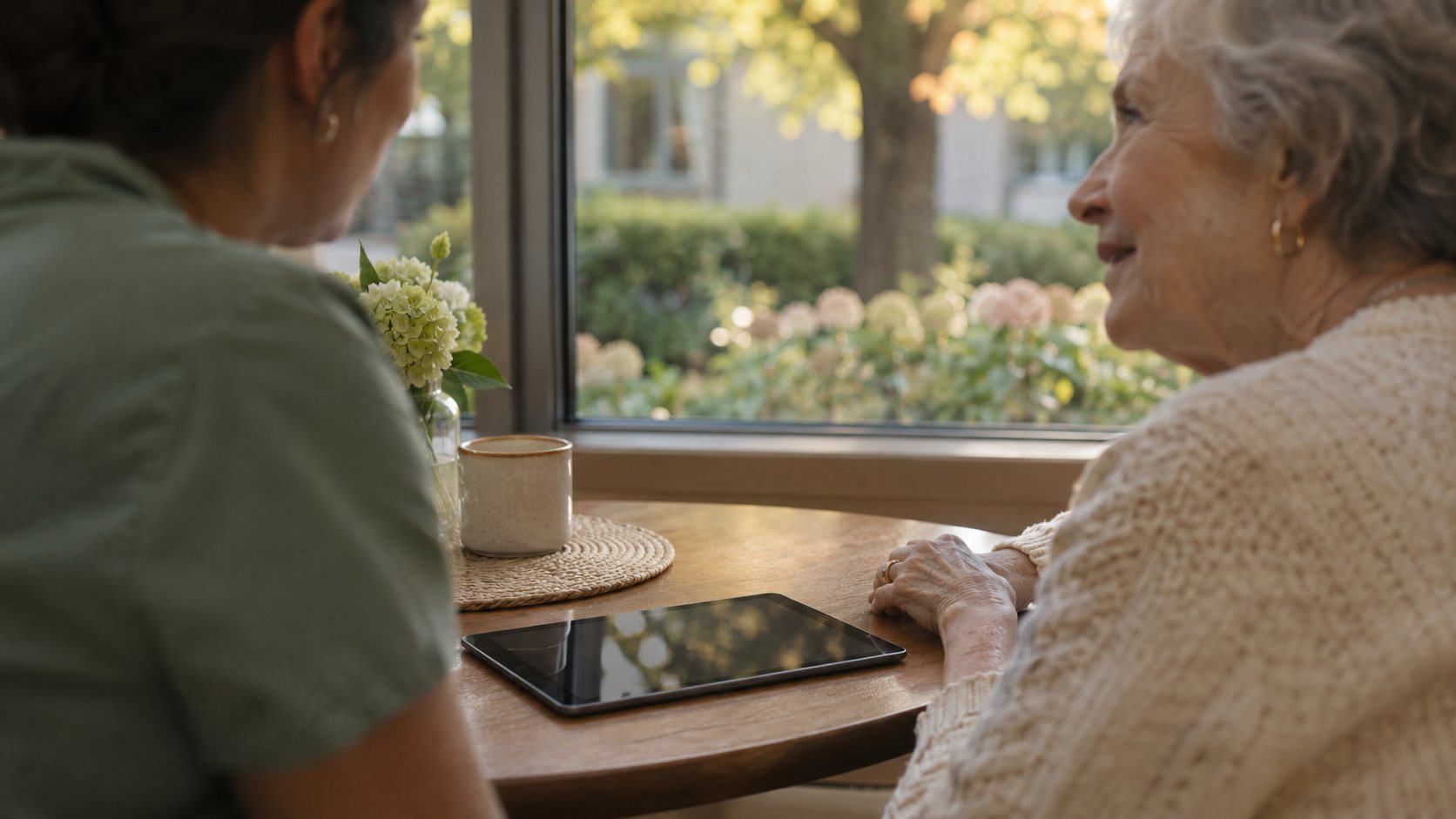
The resident has a short, guided conversation and talks freely about everyday life. An iPad is all it takes, and speech is transcribed right on the device.
Not just the answers. Broad patterns like pauses, pace, and word finding can shift before a paper screen does.
Each resident gets a plain-language next step, and your team gets a summary. Every repeat check-in is compared against that resident's own baseline.
The same short check-in, repeated every six months. Shifts too small to show up in a single score become a clear trend, and your team knows when someone has moved outside their usual range.
Shaded area: this resident's usual range
This resident's baseline. Next step: continue routine check-ins.
Illustrative resident. Values are for demonstration.
Case study
Compared against the Montreal Cognitive Assessment (MoCA), a widely used clinical screen for cognitive impairment.
3
Senior living communities
49
Residents
1min
Of speech per resident
Tracks the clinical standard
A consistent step down as MoCA drops.
Average voice score by MoCA group, scaled so 100 is the top score observed across 42 residents.
Scoring matches the clinicians
Automated scores agreed closely with speech-language pathologist scoring. Where they differed, an independent review sided with the automated result.
No examiner needed
0
clinician prompts across all three communities
Residents engaged with every task from start to finish on their own.
What happens next
One-minute check-in completed across three communities.
Scores compared with the MoCA and speech-language pathologist scoring.
Same check-in, same residents, to measure change over time.
Validation in additional senior living communities.
Results from IRB-approved research studies in senior living communities. Screening and monitoring support, not a diagnostic device.

Grounded in research
The earliest signs of cognitive change live in how we speak. We make them measurable.
Built on peer-reviewed research in speech and cognition, and developed through IRB-approved studies in senior living communities.
Early research was supported in part by the National Institutes of Health through Penn State's Center for Health Organization Transformation.
Selected publications
A 60-second interpretable voice model for early dementia screeningMekulu et al., PLOS Digital Health, 2026 Read ↗ A transparent four-feature speech model for depression screening across clinical and community settings, including assisted livingMekulu et al., Frontiers in Digital Health, 2025 Read ↗ Reimagining dementia screening: a stakeholder-informed perspective on AI, digital biomarkers, and real-world implementationMekulu et al., Journal of Alzheimer's Disease Reports, 2025 Read ↗Bring screening to your community, or help advance the research behind it.
For senior living communities
A one-minute check-in for every resident, with a clear next step for your team.
A fit for communities that:
For research partners
Join our IRB-approved studies on earlier detection of cognitive change.
A fit for communities that:
None is required. Our trained team can run check-ins on-site. If your community has capacity, your own staff can run them with the app instead.
A few minutes per resident. Most communities repeat every six to twelve months, so each resident is compared against their own baseline.
Speech is analyzed on the iPad during the check-in, and the audio is deleted right after. No resident data leaves the device, and nothing is pulled from your EHR.
Not without consent. Communities can choose to take part in our IRB-approved research studies, where residents give their own consent.
No. Results appear on the iPad as resident summaries your team can use right away.
No. DementiAnalytics is screening and monitoring support. It helps your team see who may benefit from follow-up and track change over time. It does not replace clinical judgment.
One flat annual price per community. Founding partner pricing is available for early communities. Book a 30-minute call for details.

Book straight onto our calendar. We'll walk you through a real check‑in and the summaries your team would receive.


